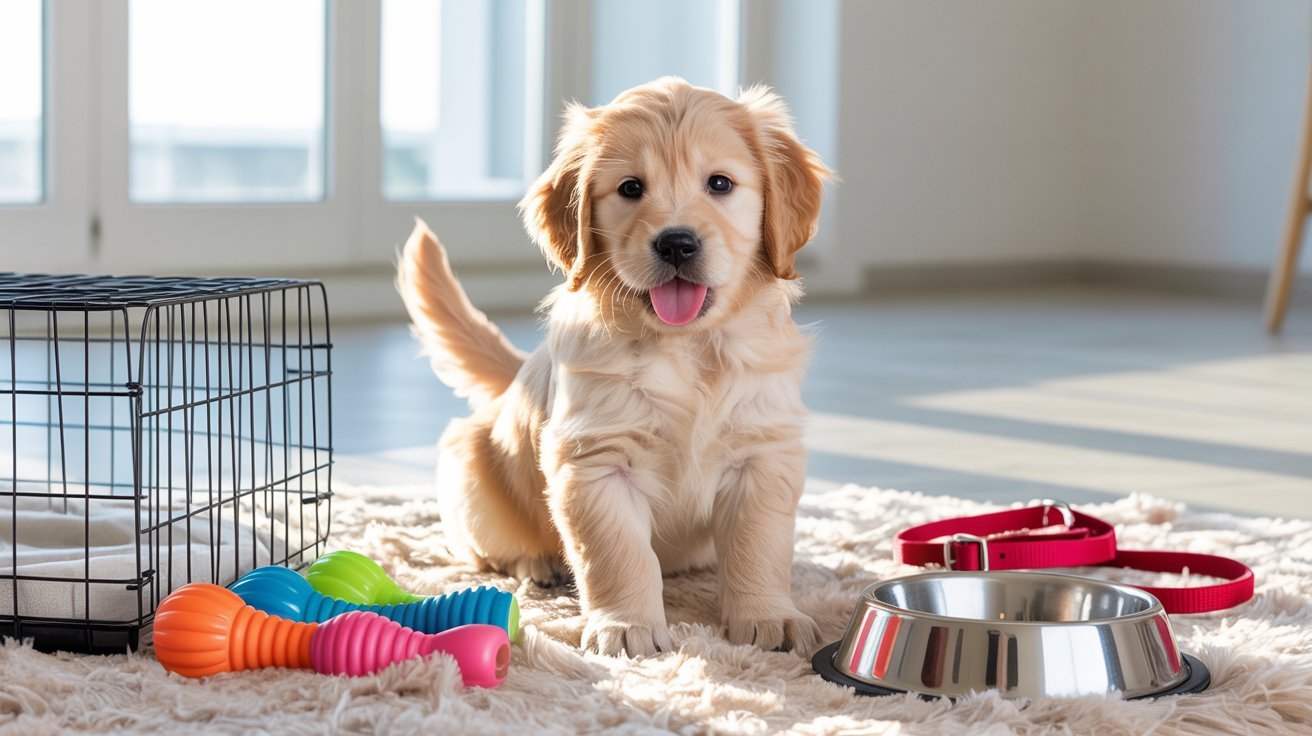
Bringing home a Golden Retriever puppy is exciting, and having the right supplies makes the transition smooth for everyone. This new puppy checklist helps first-time dog owners prepare with must-have items like crates, bowls, and toys. Save this pin for your puppy care tips and dog supplies shopping list!
New Puppy Checklist (55 Tasks) | Everything You Need Before & After Bringing a Puppy Home
Bringing a puppy home is one of those things that feels manageable until you are actually doing it. There are supplies to buy, rooms to puppy-proof, a vet to find, and a training plan to figure out — all before your new dog has even walked through the door. Getting organized early makes the first week dramatically easier for both of you.
This checklist covers all 55 tasks across five categories — supplies, puppy-proofing, vet care, training basics, and the first week at home. Use the interactive checklist to track your progress, or download the free printable PDF to work through room by room.
🐶 Use this checklist to make sure your new puppy has everything they need before and after coming home. Tasks are organized by category — supplies, safety, vet care, training, and the first week. Check off each item as you go.
🎉 All done! Your home is ready for your new puppy. Welcome to the pack! 🐾
Overall Progress
0 of 55 tasks completed
🛒 Supplies to Buy Before Puppy Comes Home
Get these ready before pickup day — not the night before
0/18▼
🏠 Puppy-Proof Your Home
Do this room by room before pickup day
0/12▼
🏥 Vet Care & Health
Schedule these within the first week
0/10▼
🎓 Training Basics
Start these from day one — the earlier the better
0/8▼
📅 First Week at Home
Focus on routine, rest, and building trust
0/7▼
What to Do Before Pickup Day
The most common mistake new puppy owners make is leaving everything to the last minute. Buying supplies the night before, scrambling to find a vet the day after pickup, and skipping puppy-proofing until after the first accident — all of these are avoidable. Set aside time at least three to five days before pickup to work through the supplies and puppy-proofing sections of this checklist.
Choosing a veterinarian before you bring your puppy home is especially important. Many practices have waitlists for new patients, and your puppy needs a first appointment within 48 to 72 hours of coming home. According to the American Veterinary Medical Association, core vaccines like DHPP and rabies should begin as early as 6 to 8 weeks — don’t let the schedule slip.
The First Week — Focus on Routine
The first week is not about teaching your puppy tricks. It is about establishing a consistent routine, building trust, and setting expectations that stick. Keep the first few days calm — limit visitors, avoid loud environments, and let your puppy explore at their own pace. A puppy that feels overwhelmed in the first days develops anxiety that can be very difficult to undo.
Crate training and potty training both start on day one — not when it is convenient. The socialization window closes around 12 to 16 weeks, so there is no time to waste on exposure to new people, sounds, and environments. Five-minute training sessions using high-value treats are enough to make meaningful progress every single day without overwhelming a young puppy’s attention span.
Frequently Asked Questions
What do you need to buy before bringing a puppy home?+
The essentials are: a crate with a divider, crate mat, food and water bowls, age-appropriate puppy food, collar with ID tag, leash, chew toys, enzymatic cleaner for accidents, training treats, and a baby gate or exercise pen. Buy everything before pickup day — scrambling to find supplies with a new puppy at home is stressful for both of you.
How do you puppy-proof a house?+
Go room by room and remove or secure electrical cords, toxic plants, cleaning products, medications, and anything a puppy could chew or swallow. Common household toxins include xylitol (found in some peanut butter, gum, and supplements), certain plants like pothos and sago palm, and human medications. Check your backyard fence for escape routes and block gaps behind appliances where a puppy could get stuck.
When should you take a new puppy to the vet?+
Schedule the first vet visit within 48–72 hours of bringing your puppy home. Choose a vet before pickup day — many practices won’t see new patients without advance scheduling. Bring all vaccination, deworming, and health records from the breeder or shelter. The first visit typically covers a full health exam, the start of the core vaccine series, parasite prevention, and microchipping if not already done.
What vaccines does a puppy need?+
The core puppy vaccines are the DHPP combination (distemper, hepatitis, parvovirus, parainfluenza) given in a series starting around 6–8 weeks, and the rabies vaccine typically given around 12–16 weeks. According to the American Veterinary Medical Association, non-core vaccines like Bordetella (kennel cough) may also be recommended based on your puppy’s lifestyle and local risk factors.
How do you potty train a puppy?+
Take your puppy outside every 1–2 hours during the day, and within 15–30 minutes of eating, drinking, waking up, or playing. Use a consistent cue word and reward immediately after they go outside. When accidents happen, clean thoroughly with an enzymatic cleaner — regular cleaners leave scent traces that attract puppies back to the same spot. Never punish accidents after the fact — puppies cannot connect punishment to something that happened more than a few seconds ago.
What is the socialization window for puppies?+
The critical socialization window is between 3 and 12–16 weeks of age. During this period puppies are most receptive to new experiences. Exposing your puppy to a variety of people, sounds, environments, and other animals during this window significantly reduces fear-based behavior problems later in life. Puppy socialization classes are an excellent way to cover a lot of ground safely before the window closes.
Should a puppy sleep in a crate the first night?+
Yes — and every night after. Starting crate training from night one is far easier than introducing it later. Place the crate in your bedroom so the puppy can hear and smell you, which reduces nighttime anxiety. Expect whining for the first few nights and do not open the crate in response to it — that teaches the puppy that whining gets results. Most puppies settle into crate sleeping within a week.
How long does it take to potty train a puppy?+
Most puppies are reliably house trained between 4 and 6 months with consistent effort, though some take up to a year. Small breeds tend to take longer because of smaller bladders. The key is consistency — same schedule, same potty spot, same reward every time. Puppies generally cannot hold their bladder longer than roughly one hour per month of age.
🛒 New Puppy Essentials We Recommend
The supplies worth getting right from day one — all available on Amazon.
🏠
Dog Crate with Divider Panel
Buy for your dog’s adult size and use the divider now. A crate that’s too big lets puppies use one end as a bathroom, slowing house training.